SEBI's AI Cyber Advisory: What the May 2026 Circular Means for Regulated Entities and AIFs
By Srushti Rao & Ayush Kedia · 2026-05-08
India's securities market infrastructure faces a category of threat that its existing cybersecurity architecture was not designed to handle. AI-powered vulnerability identification tools — capable of scanning interconnected financial systems for exploitable weaknesses at a speed and scale that human-led security operations cannot match — have moved from theoretical risk to active threat vector. On 5 May 2026, SEBI made its position on this unmistakable.
Circular No. HO/13/19/12(1)2026-ITD-1_CIMGI/10873/2026, addressed to the full spectrum of Regulated Entities across the securities market ecosystem, formally acknowledges that AI-driven vulnerability tools introduce an entirely new class of risk — and that conventional security architectures are not sufficient to address it. For AIFs, portfolio managers, RTAs, mutual funds, stock exchanges, depositories, and every other SEBI-regulated intermediary, this circular is not a reminder of existing obligations. It is a new compliance baseline.
The Regulatory Signal: Why SEBI Issued This Circular Now
What AI Vulnerability Tools Actually Do
The circular specifically references tools like Mythos — an AI-powered vulnerability detection model capable of rapidly scanning complex, interconnected systems to identify exploitable weaknesses. What makes these tools categorically different from conventional vulnerability scanners is their speed, adaptability, and scale. Where traditional security tools require known signatures or pre-defined rules, AI-based models can identify novel attack surfaces, chain together low-severity weaknesses into high-impact exploits, and do so across entire interconnected ecosystems far faster than manual or signature-based detection allows.
SEBI's Three-Dimensional Risk Assessment
SEBI has identified three distinct dimensions of risk arising from AI vulnerability tools — each of which has direct implications for how regulated entities must respond:
Heightened risk-exposure: AI tools enable the rapid identification and potential exploitation of existing vulnerabilities across interconnected systems, amplifying the consequence of any unpatched weakness. A vulnerability that would previously have taken weeks to discover and exploit can now be identified and weaponised in hours.
Data confidentiality concerns: The development or misuse of AI vulnerability tools raises the possibility of sensitive market and participant data being exposed, extracted, or compromised — including investor KYC data, transaction records, and portfolio information held across fund management platforms.
Application integrity and output reliability: AI-based models introduce uncertainty around whether system outputs remain trustworthy — raising questions about the integrity of applications that critical market infrastructure depends upon, from trading systems to regulatory reporting platforms.
The Systemic Concern Behind the Individual Risk
The circular's most important regulatory signal is not about individual firms — it is about systemic risk. SEBI's deeper concern is that because market participants are interconnected and interdependent, a vulnerability exploited at one node can cascade across the entire securities market ecosystem — exchanges, depositories, clearing corporations, and their downstream intermediaries. A breach at a single RTA or KYC agency can expose data across hundreds of regulated entities. A compromised API at one intermediary can serve as an entry point into others.
This systemic framing is why the circular's obligations are calibrated not just for large market infrastructure institutions but for every regulated entity, including AIFs and their investment managers.
The Formation of cyber-suraksha.ai
A Dedicated Task Force for AI-Specific Cybersecurity
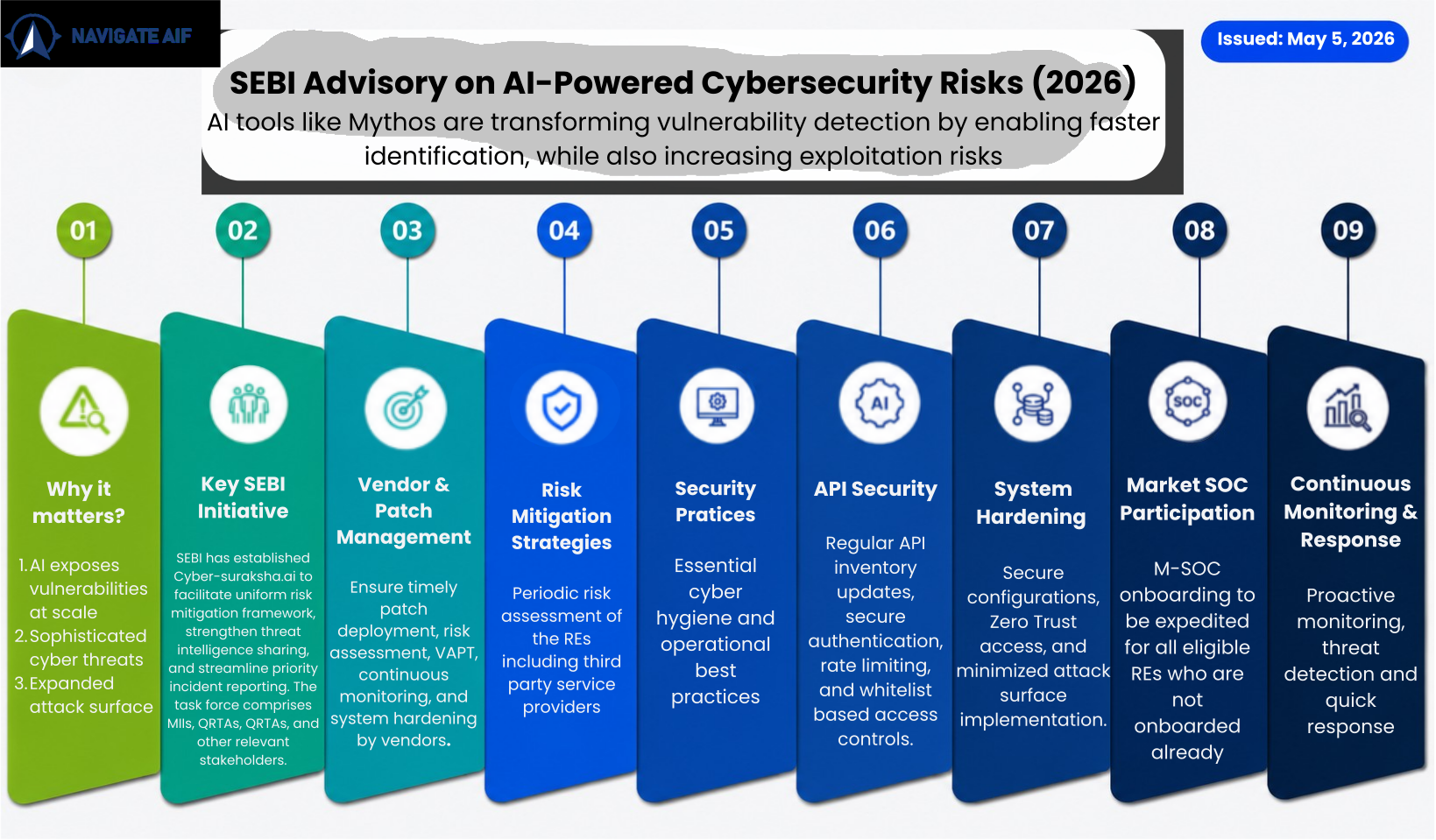
To address these risks in a structured and coordinated manner, SEBI has constituted a dedicated task force — cyber-suraksha.ai — comprising representatives from Market Infrastructure Institutions (MIIs), Qualified Registrar and Transfer Agents (QRTAs), all Qualified Regulated Entities (QREs), and other relevant stakeholders.
The task force operates under a four-part mandate:
Uniform Risk Mitigation Strategy: Closely examining cybersecurity risks posed by AI-based models and devising a standardised mitigation framework applicable across all regulated entities — ensuring that the industry responds to AI-driven threats with a coordinated posture rather than fragmented individual approaches.
Threat Intelligence Sharing: Facilitating the sharing of threat intelligence, best practices on vulnerability management, use cases, and response playbooks relevant to AI-driven threat vectors. The value of a collective intelligence approach is particularly significant for AI threats, where the speed of attack development can outpace individual firms' detection capabilities.
Priority Incident Reporting: Cyber incidents, malicious activities, significant attack vectors, and vulnerability information are to be reported on a priority basis to strengthen the overall cybersecurity posture of the securities market — creating a real-time information loop between regulated entities and SEBI.
Third-Party Vendor Review: The task force will assess the cybersecurity posture of third-party application service providers, including empaneled vendors — a mandate that directly addresses the supply chain attack surface that vendor-supplied software creates across market infrastructure.
The task force can be reached at: project-cyber-suraksha.ai@sebi.gov.in
The Advisory: Eight Compliance Requirements for Regulated Entities
1 — Patch Management and Vulnerability Assessment
REs are required to update all operating systems and applications with the latest patches immediately to address identified and known vulnerabilities. Where patches are not yet available, SEBI has recommended virtual patching as an interim protective measure. This reflects an expectation of continuous, real-time patch hygiene — not periodic review cycles that leave systems exposed between assessment windows.
Vulnerability assessments must be conducted on a regular and continuous basis, using both conventional tools and, where appropriate, AI-based Vulnerability Assessment Tools. Security audits must be undertaken in accordance with SEBI's existing Cyber Security and Cyber Resilience Framework (CSCRF).
2 — Third-Party Vendor Obligations
SEBI has extended compliance expectations directly to REs' third-party vendors — a structurally significant expansion of the accountability perimeter. REs are expected to engage with their vendors to ensure timely patch releases and appropriate deployment.
Exchanges and depositories carry a specific additional obligation: they must direct their empaneled application vendors — including those providing commercial off-the-shelf (COTS) solutions to market members — to undertake comprehensive assessments of risks arising from AI-led vulnerability detection models. Following such assessments, vendors are expected to implement safeguards including patching, Vulnerability Assessment and Penetration Testing (VAPT), continuous monitoring, and system hardening measures.
For AIFs and investment managers, this means that vendor contracts with fund administration software providers, KYC platforms, and RTA services must be reviewed to ensure these obligations can be flowed down.
3 — Change Management
Any change to systems — explicitly including minor changes — must encompass full documentation, thorough impact analysis, structured review, rigorous testing, and secure deployment. SEBI's framing leaves no room for informal or expedited change processes that bypass standard controls. In the context of AI-driven threats, even minor system changes can introduce new attack surfaces if not properly assessed before deployment.
4 — API Security
Given the centrality of APIs to modern market infrastructure — and their particular vulnerability to AI-assisted attack — SEBI has laid out specific API security requirements:
- REs must maintain an updated inventory of all APIs and the applications consuming them
- Authentication and authorisation mechanisms must be robust, ensuring verified client identity and enforcing least-privilege access
- API rate limiting and throttling must be implemented to detect and prevent abuse
- API connections must be governed on a strict whitelist-based approach — only explicitly approved connections are permitted, with all others blocked by default
For AIFs using third-party platforms or integrated data services, the API inventory requirement has immediate operational implications: every integration point must be documented, authenticated, and governed.
5 — SOC Monitoring and M-SOC Onboarding
Security Operations Centre (SOC) monitoring must be conducted on a day-to-day basis. Notably, SEBI has specified that low-priority SOC alerts must also be adequately examined — a reminder that threat actors increasingly exploit overlooked signals at the lower end of the alert severity spectrum. AI-driven attacks frequently begin with low-severity probing that human analysts deprioritise.
Where feasible, REs should implement enhanced Security Orchestration, Automation and Response (SOAR) playbooks integrated with Security Incident and Event Management (SIEM) solutions, following thorough testing.
SEBI has also directed attention to the Market SOC (M-SOC) — the centralised security platform established by NSE and BSE that provides 24x7 real-time monitoring and threat detection across market digital infrastructure. All eligible REs that are not yet onboarded with any M-SOC have been directed to expedite that onboarding. MIIs are additionally required to conduct awareness and handholding programs, including periodic workshops, to support smooth integration.
6 — Risk Assessment
Under SEBI's CSCRF, periodic risk assessments of REs including their third-party service providers are already mandated. This circular adds specificity: risk assessments must now include comprehensive scenario-based testing covering both internal and external cybersecurity risks in the RE's IT environment. Explicitly, the capabilities of AI-based models must be considered as one of the risk scenarios assessed — not as an optional stress-test but as a required component of the risk assessment framework.
7 — System Hardening and Asset Management
REs must implement system hardening through:
- Secure configurations and disabling of unnecessary services and default accounts
- Least-privilege and Zero Trust Network Architecture (ZTNA) principles to minimise the attack surface
- Asset inventories and Software Bills of Materials (SBOMs) that are periodically updated for all critical applications, including open-source components
The SBOM requirement is particularly relevant for platforms that rely on open-source libraries — a common feature of modern fintech and fund management software — where vulnerabilities in upstream dependencies can be exploited even without any direct compromise of the RE's own code.
8 — Long-Term AI Governance
The final and most forward-looking requirement addresses AI governance at an institutional level. MIIs and other REs are directed to seek guidance from their IT committees for mitigating risks from AI-led vulnerability detection models. Beyond immediate mitigation, all REs are required to prepare a long-term plan covering:
- Recalibrating risk frameworks for AI-accelerated threats
- AI-augmented SOC transformation — integrating AI tools into security operations to match the speed of AI-driven attacks
- Continuous vulnerability management capabilities using AI tools
- Agentic mitigation — developing the institutional capacity for autonomous or AI-assisted threat response
SEBI is not merely asking regulated entities to defend against AI-driven threats. It is asking them to build the institutional capacity to respond to those threats using AI themselves. This is a fundamental shift in the cybersecurity posture expected of market participants — from reactive defence to proactive, AI-enabled resilience.
What This Means for AIFs and Investment Managers
The AIF-Specific Exposure Surface
AIFs and their investment managers hold and process significant volumes of sensitive data — investor KYC records, bank account details, UBO disclosures, tax declarations, portfolio information, and capital account statements. This data flows through multiple systems and vendors: fund administration platforms, KYC agencies, RTAs, depositories, and cloud infrastructure. Each of these integration points is an API connection, a vendor relationship, and a potential attack surface.
The circular's obligations — continuous patching, vendor assessments, API whitelisting, SOC monitoring, and scenario-based risk assessment including AI-specific scenarios — apply to every regulated entity, including AIFs. Investment managers that have treated cybersecurity as an IT function rather than a compliance function will need to reassess that posture.
The DPDP Act Intersection
SEBI's AI cybersecurity advisory and the DPDP Act's "reasonable security safeguards" obligation operate on the same underlying data. An AI-driven vulnerability exploit that exposes investor KYC data simultaneously triggers:
- SEBI enforcement for failure to maintain the cybersecurity posture mandated under the CSCRF and this circular
- DPBI penalties of up to ₹250 crore for failure to implement reasonable security safeguards under Section 8(1) of the DPDP Act
- Mandatory breach notification to affected investors and the Data Protection Board within 72 hours
The two frameworks are not alternatives. They are a compounding compliance obligation that makes robust cybersecurity infrastructure a financial imperative, not just a regulatory one.
Immediate Actions for AIF Compliance Teams
Vendor contract review: Review all agreements with fund administration software providers, KYC platforms, and other technology vendors to confirm they include obligations around patch management, VAPT, and vulnerability assessment. Flow-down clauses aligned with SEBI's third-party vendor requirements should be incorporated into contract renewals.
API inventory: Document every active API integration — with depositories, KYC agencies, RTAs, and other data providers — and confirm that authentication, rate limiting, and whitelist-based access controls are in place.
Risk assessment update: Ensure that the next periodic risk assessment explicitly includes AI-based vulnerability detection as a scenario — with documented analysis of the RE's exposure to AI-driven attack vectors.
M-SOC onboarding check: Confirm whether the fund management platform qualifies as an "eligible RE" for M-SOC onboarding, and if so, initiate the process without delay.
IT committee briefing: Brief the fund's IT committee or technology oversight function on the long-term AI governance requirement — including the obligation to prepare a plan for AI-augmented security operations and continuous vulnerability management.
Why the Formation of cyber-suraksha.ai Matters Beyond Individual Compliance
The creation of a dedicated, SEBI-constituted task force focused specifically on AI-driven cybersecurity threats is architecturally significant. It signals that SEBI views this as a permanent, structural feature of the securities market threat landscape — not a transient risk requiring a one-time advisory response.
Threat intelligence sharing across MIIs, QRTAs, and QREs through a centralised task force creates a collective defence capability that individual regulated entities cannot replicate independently. The speed at which AI-driven vulnerabilities can be developed and weaponised makes collective intelligence — where a threat identified at one node is rapidly shared across the ecosystem — a meaningful defensive advantage.
For regulated entities, engagement with cyber-suraksha.ai is not merely encouraged — it is the operational mechanism through which SEBI expects the industry's collective cybersecurity posture to improve.
Conclusion: AI-Driven Threats Are a Present Compliance Obligation
SEBI's 5 May 2026 circular marks a decisive regulatory pivot. The eight requirements it introduces — from continuous patch management and API security to M-SOC onboarding and long-term AI governance — collectively define a new cybersecurity baseline for every regulated entity in the securities market ecosystem. AI-driven vulnerability tools are no longer a speculative future risk. They are a present compliance obligation.
For AIFs and investment managers, the practical path forward requires:
- Continuous patch hygiene — not periodic review cycles — across all systems and vendor platforms
- API inventory and whitelisting for all active integrations
- Vendor contract updates flowing down SEBI's third-party assessment and safeguard requirements
- Scenario-based risk assessments explicitly incorporating AI-specific threat vectors
- M-SOC onboarding for all eligible entities
- Long-term AI governance plans addressing SOC transformation, continuous vulnerability management, and agentic mitigation capabilities
The circular's most important message is its final one: regulated entities must not only defend against AI-driven threats — they must build the institutional capacity to respond to them using AI. That is the long-term compliance standard SEBI is now setting for India's securities market ecosystem.
This analysis is based on SEBI Circular No. HO/13/19/12(1)2026-ITD-1_CIMGI/10873/2026 dated 5 May 2026. It is intended for informational purposes only and should not be construed as legal or compliance advice. Regulated entities should consult their legal, compliance, and technology advisors to assess the implications of the circular for their specific IT environments and vendor relationships.
Assessing your AIF's cybersecurity posture against SEBI's new AI advisory requirements? Contact Navigate AIF to understand how the May 2026 circular interacts with your fund's CSCRF obligations, DPDP Act compliance, and vendor management framework — and what steps your investment manager needs to take before your next risk assessment cycle.