
From Consultation to Regulation: Analysing SEBI's Framework on Winding Up of Alternative Investment Funds and the Introduction of 'Inoperative Fund' Status
By Srushti Rao & Bhavya Sureka · 2026-06-18
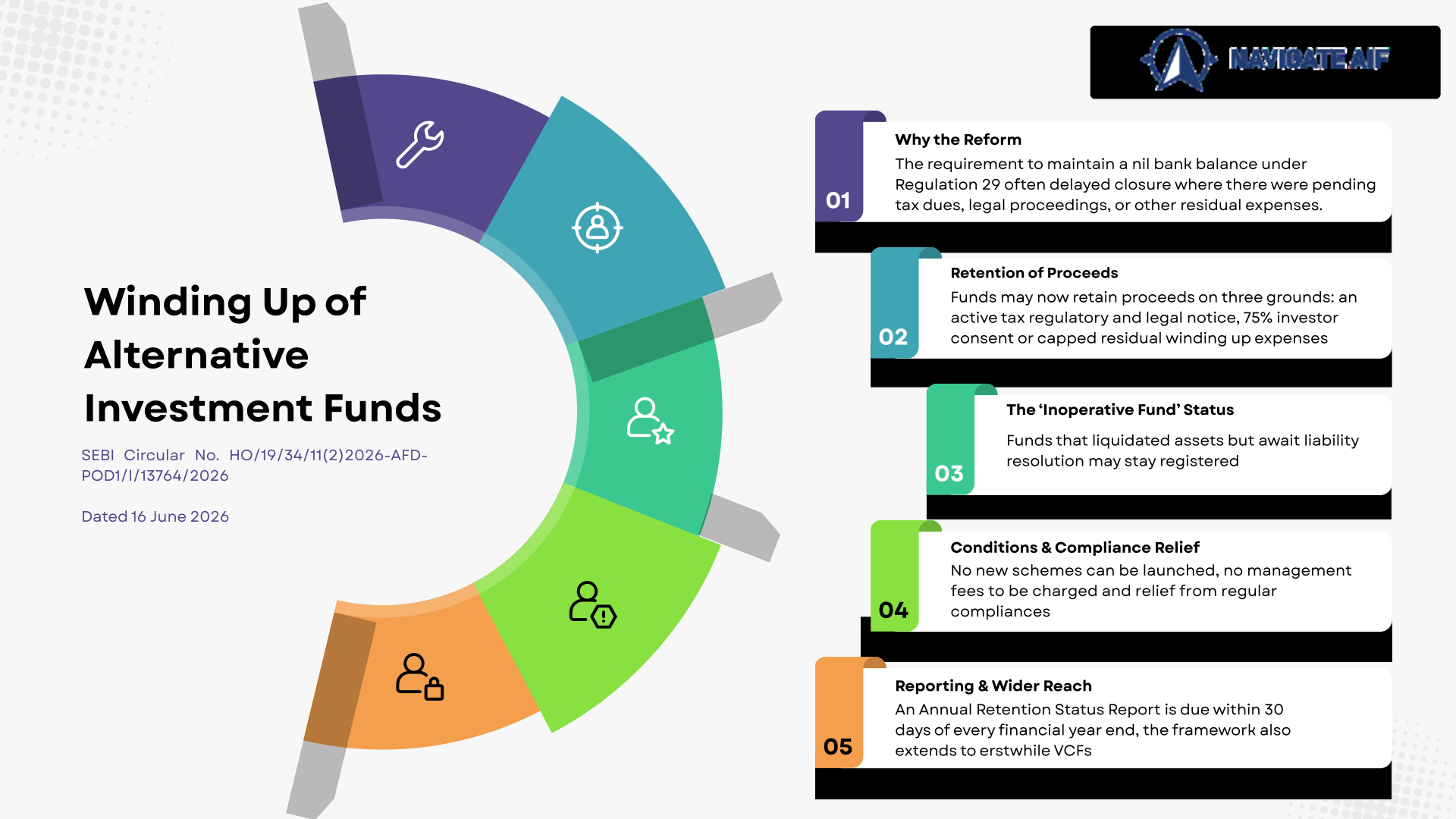
FROM CONSULTATION TO REGULATION: SEBI'S NEW FRAMEWORK ON WINDING UP OF AIFS
The Securities and Exchange Board of India ("SEBI") has issued a new Circular dated 16 June 2026 ("Circular"), prescribing the operational framework for retention of proceeds beyond the permissible life of an Alternative Investment Fund ("AIF") and introducing the concept of an "Inoperative Fund" status.
The framework follows amendments to the SEBI (Alternative Investment Funds) Regulations, 2012 ("AIF Regulations"), giving effect to proposals contained in SEBI's Consultation Paper on Flexibility to AIFs in Winding up the Scheme / Surrendering the Registration, released on 5 February 2026 ("Consultation Paper"). The Circular addresses a long-standing operational challenge AIFs face while winding up and surrendering their certificate of registration, marking a significant policy shift toward greater flexibility while keeping investor protection and regulatory oversight intact.
WHY WAS THIS CIRCULAR REQUIRED?
Regulation 29 of the AIF Regulations governs winding up: scheme assets must be liquidated within the prescribed period, net proceeds distributed to investors after settling liabilities, and the AIF's certificate of registration surrendered once winding up is complete.
In practice, this linear process often breaks down where liabilities remain unresolved even after every investment has been liquidated. A tax authority may have raised a demand or opened an assessment; litigation may be pending or anticipated, leaving the manager or trustee exposed to personal liability if all proceeds are distributed too soon; or residual winding-up costs such as audit fees, legal retainers, or trustee charges may continue to accrue after the last investment is sold. Because the rules effectively required a NIL bank balance before registration could be surrendered, even a small retained amount blocked an AIF from closing out completely.
To resolve this, SEBI released a Consultation Paper proposing a more pragmatic approach: permitting limited retention of proceeds and introducing an "Inoperative Fund" framework.
KEY PROPOSALS INCORPORATED INTO THE FINAL CIRCULAR
The Circular confirms that SEBI has accepted the substantive proposals in the Consultation Paper. It formally permits retention of liquidation proceeds beyond the permissible AIF life under specified circumstances, introduces the Inoperative Fund regime, provides regulatory relaxations for such AIFs, and sets out a structured reporting framework until all liabilities are discharged.
An AIF may retain liquidation proceeds beyond its permissible life where any one of the following grounds exists:
-
An actual litigation notice or demand has been received: The AIF must have received written communication from a tax authority, regulator, law enforcement agency, court, investor, or counterparty indicating a potential tax, regulatory, or legal liability. This covers show-cause notices, re-assessment notices, and investigation summons — the AIF need not wait for a final, quantified demand before retaining funds.
-
Investor consent for anticipated liabilities: Where a liability is anticipated but no formal demand has been issued, the AIF may retain proceeds with approval from at least 75% of investors by value. The manager must disclose the amount proposed to be retained and the estimated duration of retention.
-
Residual winding-up operational expenses: An AIF may retain proceeds to meet residual operational expenses, supported by invoices, documentary evidence, or comparable historical expense records. Retention on this ground cannot continue beyond three years from the end of the permissible AIF life, and the Standard Setting Forum of AIFs ("SFA") will formulate standardised operational expense heads in consultation with SEBI.
How must retained proceeds be invested? Regardless of which ground applies, all retained monies must be invested in accordance with Regulation 15(1)(f) of the AIF Regulations, which governs permitted investments of an AIF's uninvested corpus, so the money remains productively deployed while the underlying liability is resolved.
What happens once the liability is resolved? Once pending liabilities are satisfied and retained monies distributed to investors, the scheme must be formally wound up under Regulation 29 of the AIF Regulations.
THE 'INOPERATIVE FUND' FRAMEWORK
The introduction of the Inoperative Fund category is the Circular's most significant reform. It recognises that many AIFs have effectively ceased investment activity and liquidated all assets, yet remain registered solely because certain liabilities are still unresolved. Eligible AIFs may now apply to SEBI for Inoperative Fund status.
Two categories of AIF can apply: those with one or more schemes that have retained proceeds on one of the three grounds above and intend to eventually surrender their registration, and those whose schemes have not retained any money beyond the permissible AIF life but wish to keep their registration alive because of an anticipated favourable outcome in pending litigation.
The application is submitted in the format prescribed in Annexure A of the Circular, by email to inoperativeaif@sebi.gov.in.
Once granted Inoperative Fund status, an AIF can effectively cease commercial operations while remaining legally registered until outstanding liabilities are resolved. Three consequences follow immediately from the date of tagging:
-
Retained monies must continue to be invested in accordance with Regulation 15(1)(f).
-
No new scheme can be launched under the AIF.
-
No management fees can be charged in respect of any of the AIF's schemes.
These restrictions keep the Inoperative Fund mechanism strictly a winding-up facilitation measure rather than a route to continue business as usual.
Reporting requirement: Inoperative Funds that have retained monies must submit an Annual Retention Status Report to SEBI and the relevant investors, filed on the SEBI Intermediary Portal within 30 calendar days from the end of March each financial year, in the format prescribed in Annexure C of the Circular.
What regulatory requirements are waived? Annexure B of the Circular lists ten regulatory requirements that no longer apply to Inoperative Funds, along with their effective dates of non-applicability:
-
Limited Quarterly Activity Reports
-
Annual Activity Reports
-
Compliance Test Reports
-
Annual PPM audit
-
Reporting to benchmarking agencies
-
Periodic investor reporting
-
Intimation of changes in the PPM
-
NISM certification requirements
-
Requirement of a custodian for safekeeping of securities
-
Valuation obligations, subject to annual reporting requirements
These exemptions substantially reduce the compliance burden on AIFs that have effectively completed their investment lifecycle, while preserving annual disclosures relating to retained monies.
APPLICABILITY TO VENTURE CAPITAL FUNDS
SEBI has extended this framework to Venture Capital Funds ("VCFs") registered under the erstwhile SEBI (Venture Capital Funds) Regulations, 1996. VCFs facing similar winding-up challenges may also retain proceeds and seek Inoperative Fund status, subject to the same conditions.
DETAILED APPLICATION PROCEDURE
Annexure A now requires detailed disclosures covering:
-
The AIF and its schemes
-
Retained proceeds
-
Reasons for winding up and retention
-
Expected timelines for resolution
-
Proposed investment of retained monies
-
Pending enforcement actions
-
Undertakings from both the manager and the trustee
This additional procedural guidance gives market participants greater certainty on implementation.
PRACTICAL IMPLICATIONS
The Circular is one of the more practical reforms introduced under the AIF regime:
-
For AIF managers, it removes a significant operational hurdle by allowing registration to continue without the full compliance burden of an economically inactive AIF.
-
For investors, it provides greater transparency through mandatory disclosures, annual reporting, and clearly defined circumstances in which monies may be retained.
-
For trustees and sponsors, structured application procedures and standardised reporting reduce ambiguity around the winding-up process and provide greater regulatory certainty.
Overall, the framework strikes a sensible balance between commercial practicality and investor protection.